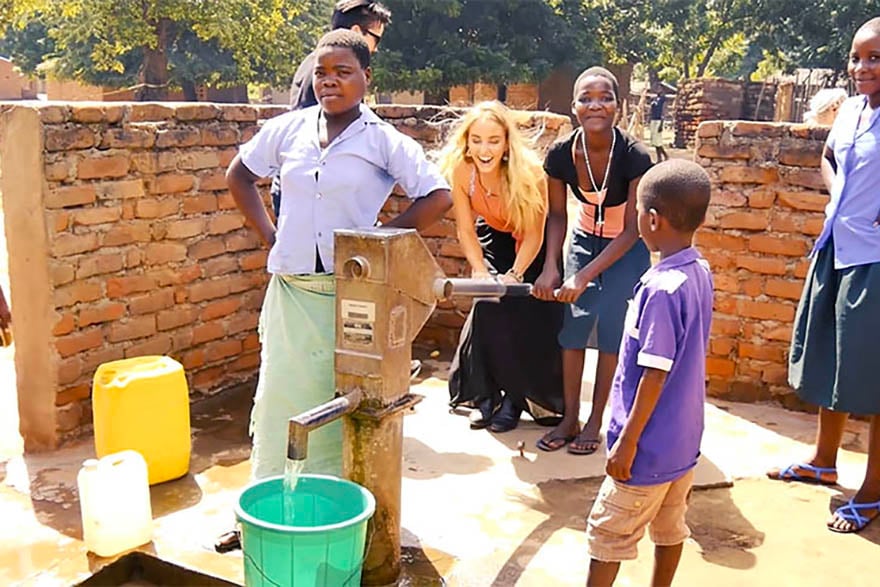
You really do deserve a pat on the back! Not only have you been fighting and winning your own battles, but you’ve also helped a lot of other people fight, and win, theirs. (Some of which you’re probably not even aware of.) So, we wanted to take this opportunity to say thank you!
SuperFastDiet donates 10% of all revenue to the Human Kind Project, which funds and supports programs like The Hunger Project in developing nations around the globe.
So far this year, we’ve donated $15,241.97 to the Human Kind Project just between January and May! And all of this is possible because of incredible members like you.
- 100 mothers are now receiving training in nutrition and health
- 85 micro-finance loans have been distributed
- 22 additional volunteers have been trained
These are just a few of the incredible stories that we’re so happy to be able to share with you…
Elisabeth
Elisabeth Obubuafo is now running multiple businesses, sending her children to school and providing food for her community. But it wasn’t always this way.
Elisabeth is an agricultural farmer in eastern Ghana in a small community near Matsekope Epicenter. Born to a poor and rural family, she had no formal education past primary school. She married young and had few prospects for a good job and feeding her three children.
Elisabeth started working with The Hunger Project ten years ago and has attended skills training, women’s empowerment workshops and adult literacy courses. Through this training, Elisabeth acquired the skills and confidence to start her own business, send her children to school and assert her rights in her home with her husband.
Thanks to microcredit loans, she was able to grow her farming business from ten acres of land to sixty. Elisabeth now hires people to work on her land and also has other businesses in fish, clothes and poultry. She is now able to send her children to school and provide a better life for them. Her husband supports her in these endeavours. In an area where women have generally been marginalised and subordinate to men, Elisabeth is a shining example of an empowered woman.
Denis
Before The Hunger Project came to his community in Malawi, Dennis Denga was living in severe hunger.
“Sometimes I found small jobs to do in exchange for food. Sometimes I would have to beg for food. Sometimes I would have to steal from my neighbours. Often, I would have to fall asleep without eating,” he said.
His life was transformed when he attended farming technique workshops in his community of Champiti. By applying what he learned, he tripled the yield of his family’s farm. His family now have enough food for the entire year and even have some produce left over to sell locally.
Thanks to entrepreneurship training and a microfinance loan he received, Dennis and his wife Bernadette are now the proud owners of a grocery store.
“I am transformed… My three-year-old son Cheos eats three times a day, every day. He has never slept on an empty stomach,” Dennis said.
Alifa
Alifa Symon’s daughter, Mary, was first birth ever at the Majete Epicenter in Malawi, and in turn symbolises the rebirth of the community.
Before The Hunger Project’s health intervention at the Chibwarizo Village, a partner village of Majete Epicenter, mothers were forced to travel 20 kilometres through bumpy terrain to give birth at a nearby partner village. This arduous journey was necessary, as it was the closest clinic. As a result, two expectant mothers were lost every year according to Village Headman Chibwarizo. Alifa herself made the journey three times before giving birth to Mary.
“We had come to accept the reality of our situation. Expectant mothers dying on the way to the hospital was the worst option for us,” Chibwarizo said.
“Such cases have been distracting all of us from taking the perilous journeys; no wonder people started giving birth within their homes though knowing that too was a recipe for disaster. For leaders, we could not do more. How could you encourage people to go the hospital in such a situation?”
The community can now look forward to future deliveries.
Fathimath
At Lahotan Epicenter in central Benin, The Hunger Project-Benin is working with the local community to staff and expand a small health clinic and to promote its services among community members.
Fathimath Omighessan, 28, is an epicenter midwife who has worked at the clinic for a year. At regular intervals, a doctor is present at the clinic as well. Before she arrived in Benin, Fathimath had a job in a private clinic in Togo, a neighbouring country. Her previous clinic was equipped for surgery and she is accustomed to providing complex care.
At first, patients were slow to come to the clinic. “Not many people believe they will find quality care so close to home. Most people wait, hoping their medical complaints will disappear, or until they are very ill. When that happens, they are often beyond our help. This is really sad,” said Fathimath.
To change the community perception of the epicenter clinic, Fathimath partnered up with Justin Dividé, the chairperson of the health committee. Together, they are working to shift the mindset of people in their community by educating them about the importance of health care and regular health visits.
“Justin truly is my right hand. He often accompanies me on house calls, for instance, because the people around here tend to take him more seriously than an outsider, like myself. Last year we visited every surrounding village to explain what we offer in the clinic,” said Fathimath.
“It’s for the well-being of my village, so Fathimath can always call on me when she needs my help. I am glad I have been able to convince people of her qualities,” Justin adds.
Today, more and more people are beginning to use the clinic, which is making a significant impact on the surrounding villages. Community members can deliver their children and be treated much closer to home. By using the health clinic instead of driving to a larger hospital, they are also able to save money. In addition to requiring less gasoline to get to there, they also don’t need to purchase food during their hospital stay, since they’re close enough to cook at home and bring food to the clinic. Newly pregnant couples are now asking the clinic to acquire an echo-scanner, so they can find out if they are carrying a boy or a girl.
“I really hope I will be able to stay,” says Fathimath. “I feel I can really make a difference here.” Fathimath is happy she has been able to contribute to a shift in the way her community thinks about health care.
Amina
Amina from Ghana could not see any way out of the repetitive daily struggle to survive. She had no hope for the future. Thankfully, that all changed.
Her life used to involve spending days gathering wood, walking for hours to collect water, and back-breaking work in the fields to try and grow enough food to feed her family. Every day was the same for Amina.
“My children didn’t go to school. Why would they need to go to school just to work in the fields?” Amina said.
Her life changed when she attended one of The Hunger Project’s workshops where she learned that she had the power to change her life. For the first time, she created a vision for her future, made a commitment to herself, and learned how to take action and achieve her new visions.
“Now I have a successful soap making business, I have learned how to grow vegetables and make nutritious meals for my family and I have a beautiful vegetable garden. My children go to school and I work with my husband in his business. Together we make joint decisions about our children and our money,” Amina said.
And these stories are made possible because of people like you. You can learn more about how the Super Squad supports the Human Kind Project, by visiting How We Give.