
Are We There Yet?
You’re fasting like a hibernating bear, you’ve been exercising more than you used to, your meals are lean and full of superfoods and you drink more water than ever, but… you’re not losing weight? What’s the deal?! Fear not, you’ve just hit a weight loss plateau. Try your best not to let your frustration throw you off or cause you to throw your hands up, because you are doing everything right!
Really? Again?
Yep. Sorry. This is the thing with weight loss plateaus – it’s normal to hit more than one in a weight loss journey. Dr. Krista Varady explained it to us like this: “People will also find that they hit multiple plateaus, and that is quite normal. So, you may hit a plateau at six weeks, and then again later on at around fifteen or twenty weeks. It’s quite normal.” And it’s especially common for Master Fasters, because the last few kilos are always the hardest. But they’re within your reach. So don’t fret if you hit a plateau at this point.
What’s The Set Point Weight Theory?
There is a theory which says that your body has a ‘set point’ – that is, a weight at which it is comfortable, which will make it difficult to lose more weight. Dr. Krista Varady explains it like this: “We use something called the Body Mass Index or BMI to judge whether or not people are obese or overweight or normal weight. And a lot of people struggle to lose more weight when they’re in the normal range of BMI – so that’s anywhere from 18.5 to 25… So if you’re within the normal weight range, it is going to be harder to lose weight because your body doesn’t want to lose any more weight.”
This doesn’t mean you can’t lose more weight if you want to, it just means it’s going to be a little harder, or it’s going to take a little longer. In saying that, it is possible to break through a plateau and see that whoosh. Ok, enough about plateaus – onto explaining the whoosh.
Here’s What You Don’t See On The Scales
(Or in your measurements) when you hit a plateau in your weight loss journey. The scientific hypothesis[1] behind this weight loss plateau is that it can be misleading and the key to the mystery is water retention. Sound confusing? Here’s the explanation: basically, when you start losing weight, your body empties its fat cells of triglyceride (the fat that lives in your blood) as it gets burned up for energy. But this isn’t visible to the human eye.
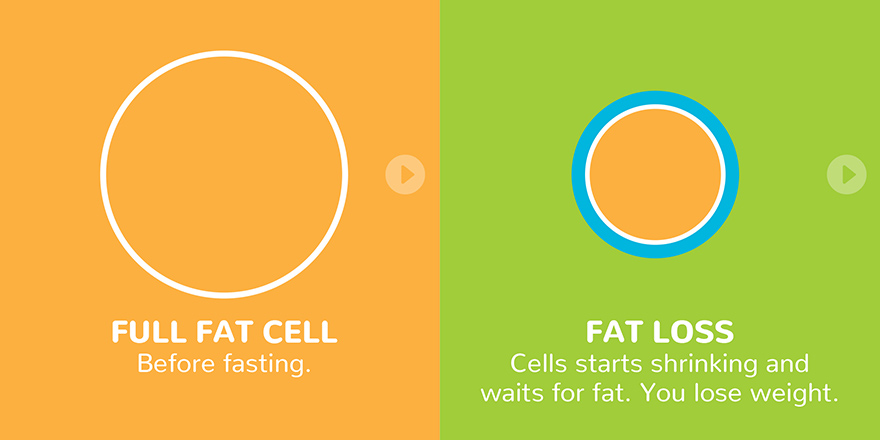
However, (this is the part of the act where you keep an eye of the magician’s other hand) as soon as the fat cells are emptied of fat, they temporarily get refilled with water. This means that while you mightn’t look smaller and the water that you’re carrying adds up on the scales, you actually have less fat! This illusion can be incredibly discouraging, especially when you’re working exceptionally hard and not seeing results.
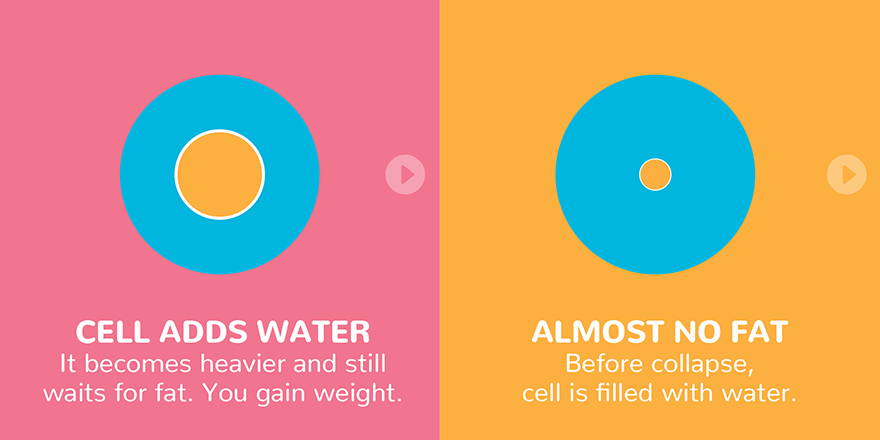
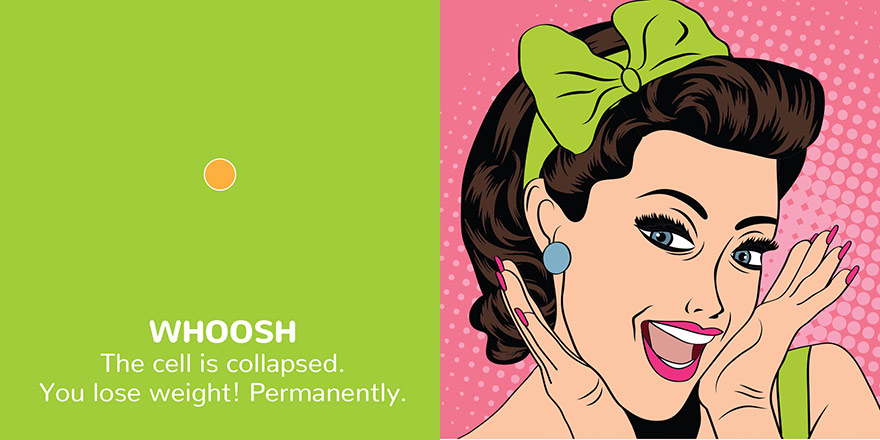
But, after some time (it’s different for everyone; it may be a few days or many weeks, depending on how close you are to your goal weight and how hard you’re fasting and exercising), your fat cells suddenly drain their temporary water storage and you will experience a whoosh [2] (also referred to as LTDFLE or “Long-Term Delayed Fat Loss Effect”) that makes you feel – and look – slimmer and lighter literally overnight.
The Whoosh Effect
When your body is in a state of caloric deficit (burning more calories than you’re consuming), weight loss plateaus, and subsequent whooshes, are part of a natural pattern. Try not to concentrate on them too much or let them do your head in. Remember that you are making progress even when it doesn’t feel like it, and even when the scales don’t show it. Because, as we’ve illustrated above, while (like the camera) scales can’t lie… they can be an accessory to untruth!
The intermittency of this way of life is what spurs these whooshes into action; the contrasting stages of fasting and feasting give your body the opportunity to ‘reset’ every once in a while and flush out its excess fluid. Woo hoo!
And that’s The Whoosh Effect Explained, Master Fasters. Tell us about your plateau and whoosh experiences in the comments, and make sure to jump over to the Members’ Only Facebook group to share your wins and losses. We love hearing about them!
[1] Keys, A., Brožek, J., Henschel, A., Mickelsen, O., & Taylor, H. L., The Biology of Human Starvation (2 volumes), University of Minnesota Press, 1950.
[2] A whoosh is also referred to as LTDFLE (Long-Term Delayed Fat Loss Effect)